Complete guide with expert tips, examples, and dos & don'ts for writing a biodata that makes a great first impression.
Your marriage biodata is often the first impression you make on potential matches and their families. While having a beautiful template is important, what you write in your biodata matters even more. The right words can highlight your strengths, showcase your personality, and make families want to know more about you.
Many people struggle with how to present themselves in a biodata. Should you be formal or friendly? How much detail is too much? What information should you include or leave out? This comprehensive guide will answer all these questions and help you create a biodata that stands out for all the right reasons.
Whether you're creating a traditional Hindu biodata, a Muslim nikah biodata, or a modern professional format, the principles of good writing remain the same: be honest, be clear, and be compelling.
Quick Tip: Before writing, ask yourself: "Would I want to meet me based on this biodata?" If the answer is no, keep refining!
Before you start writing, it's crucial to understand who will read your biodata. In most arranged marriage scenarios, your biodata will be read by:
They focus on family background, values, education, and career stability
They look for personality, interests, compatibility, and lifestyle
They consider cultural fit, social standing, and traditional values
Your biodata must appeal to all three audiences. This means balancing traditional values with modern sensibilities, providing enough detail without overwhelming readers, and presenting yourself authentically while highlighting your best qualities.
Let's break down how to write each section of your biodata with specific examples and tips:
What to Include:
✅ Good Example:
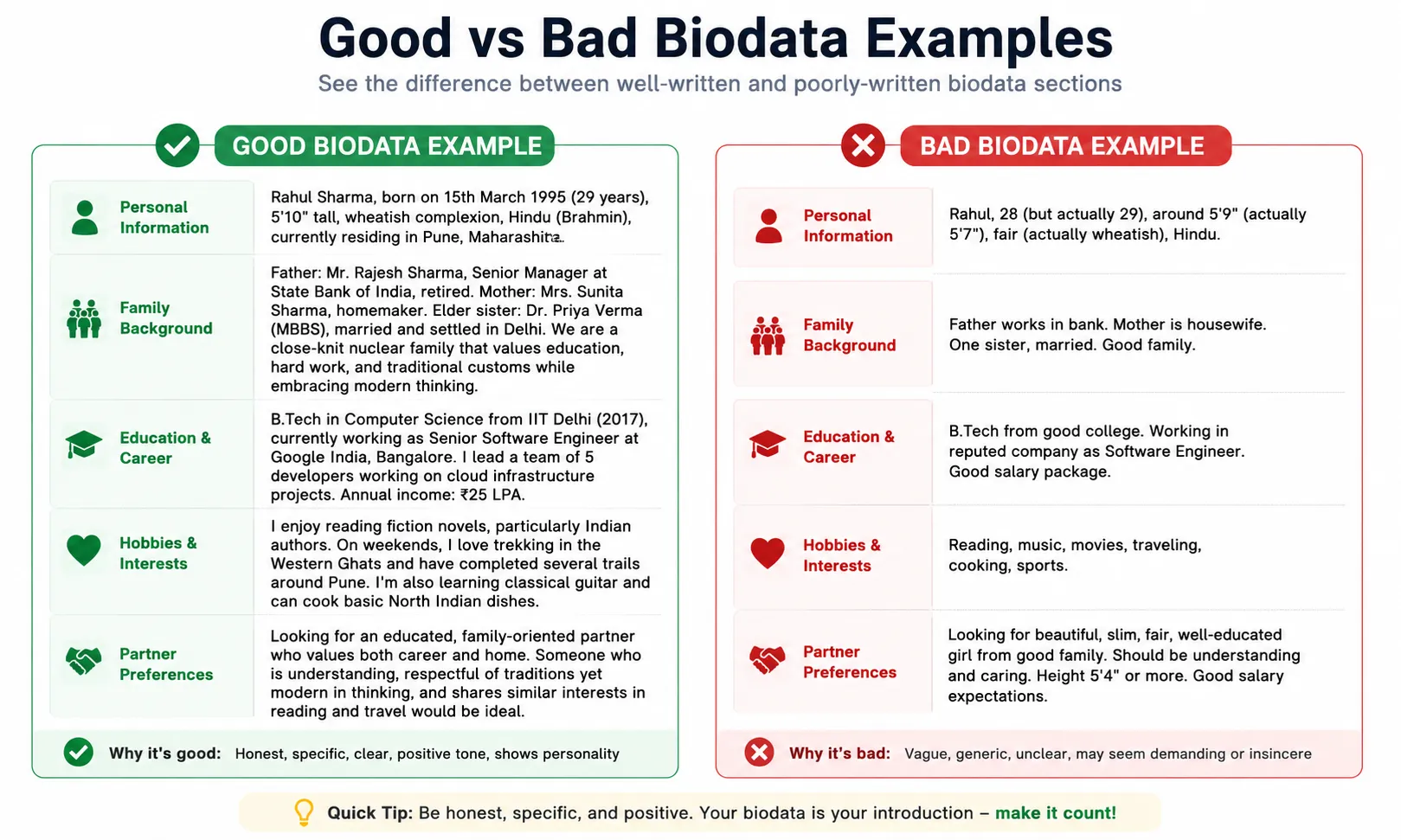
"Rahul Sharma, born on 15th March 1995 (29 years), 5'10" tall, wheatish complexion, Hindu (Brahmin), currently residing in Pune, Maharashtra."
❌ Poor Example:
"Rahul, 28 (but actually 29), around 5'9" (actually 5'7"), fair (actually wheatish), Hindu."
Important: Never lie about your age, height, or other basic details. Honesty builds trust from the start.
How to Present Your Family:
✅ Good Example:
"Father: Mr. Rajesh Sharma, Senior Manager at State Bank of India, retired. Mother: Mrs. Sunita Sharma, homemaker. Elder sister: Dr. Priya Verma (MBBS), married and settled in Delhi. We are a close-knit nuclear family that values education, hard work, and traditional customs while embracing modern thinking."
❌ Poor Example:
"Father works in bank. Mother is housewife. One sister, married. Good family."
What Makes a Strong Professional Section:
✓ DO Write:
✗ DON'T Write:
✅ Good Example:
"B.Tech in Computer Science from IIT Delhi (2017), currently working as Senior Software Engineer at Google India, Bangalore. I lead a team of 5 developers working on cloud infrastructure projects. Annual income: ₹25 LPA."
This section adds personality to your biodata. It helps potential matches see you as a real person with interests beyond work and family.
✅ Good Example:
"I enjoy reading fiction novels, particularly Indian authors. On weekends, I love trekking in the Western Ghats and have completed several trails around Pune. I'm also learning classical guitar and can cook basic North Indian dishes."
❌ Poor Example:
"Reading, music, movies, traveling, cooking, sports."
Notice the difference? The good example provides specific details that give insight into your personality, while the poor example is a generic list that could apply to anyone.
This is the trickiest section to write. You need to be clear about your expectations without sounding too demanding or unrealistic.
✓ Focus on Values & Compatibility:
✗ Avoid Being Too Specific About:
✅ Good Example:
"Looking for an educated, family-oriented partner who values both career and home. Someone who is understanding, respectful of traditions yet modern in thinking, and shares similar interests in reading and travel would be ideal. Open to matches from similar cultural background who are settled in India or abroad."
Strike a balance between formal and friendly. You want to sound respectful and sincere without being stiff or robotic.
Good: "I enjoy spending quality time with family and friends."
Too Formal: "I derive immense satisfaction from familial interactions."
Too Casual: "I love chilling with fam and friends lol."
Your biodata should be 1-2 pages maximum. Provide enough information to be interesting, but not so much that readers get overwhelmed.
Use bullet points for lists
Break text into paragraphs
Remove unnecessary details
Problem: "I am a good person from a good family looking for a good match."
Why it's bad: Doesn't tell families anything specific about you. Everyone claims to be "good."
Problem: "I am the best employee in my company and everyone loves me. My family is the most respected in our community."
Why it's bad: Sounds arrogant and off-putting. Let your achievements speak for themselves.
Problem: "I have complited my MBA form delhi university and working in good compny."
Why it's bad: Creates impression of carelessness. Always proofread multiple times!
Problem: "Not looking for working women" or "Should not have any bad habits."
Why it's bad: Focus on what you DO want, not what you don't. Frame preferences positively.
While the photo itself is visual, how you present yourself in the photo reflects your writing decisions. Here's what works:
Different communities have different expectations. Here's how to adapt your writing:
Include gotra, nakshatra, rashi, manglik status if relevant. Mention religious practices if important to you.
Example: "Born under Rohini nakshatra, Vrishabha rashi. Non-manglik. We follow traditional Hindu customs and celebrate all major festivals."
Mention sect if relevant, commitment to prayer and Islamic values. Family's religious background.
Example: "Sunni Muslim family. Regular with five daily prayers. Looking for someone who shares similar religious values and practices."
Church affiliation, denomination if important. Community involvement and faith practices.
Example: "Catholic family, active members of St. Mary's Church. We value Christian principles and are involved in community service."
Visa status, citizenship, willingness to relocate. Connection to home country.
Example: "US citizen working in San Francisco. Open to settling in India or USA. Visit India annually and maintain strong family ties."
Proofread for spelling and grammar errors
Verify all phone numbers and email addresses
Check that dates and ages are accurate
Ask a family member to review it
Ensure tone is positive throughout
Remove any negative or demanding language
Confirm all information is honest and accurate
Check that it fits within 1-2 pages
Pro Tip: Save multiple versions! Create one detailed version for close family references and a slightly condensed version for wider circulation on matrimonial sites.
Include personal details (name, age, height, education), family background (parents, siblings), professional information (job, company), hobbies and interests, and partner preferences. Be honest and concise throughout.
A perfect biodata should be 1-2 pages long. Include all essential information without making it too lengthy or overwhelming. Focus on quality over quantity.
Use a formal yet friendly tone. Be respectful, honest, and positive. Avoid being too casual (like chatting with friends) or overly formal (like writing a legal document).
Including salary is optional but recommended. Many families appreciate transparency about financial status. You can mention annual income or salary range. If uncomfortable, you can write "Details will be shared upon further discussion."
Light humor is acceptable if it's tasteful and appropriate. However, keep it minimal. Remember that different people have different senses of humor, and what you find funny might not resonate with everyone. When in doubt, stay professional.
Focus on values and compatibility rather than physical attributes or material requirements. Use phrases like "would prefer" or "looking for" instead of "must have" or "only want." Frame everything positively and be reasonable in your expectations.
Writing a great biodata takes time and thought, but it's worth the effort. Your biodata is often the first impression you make on potential matches and their families. A well-written biodata can open doors and start meaningful conversations.
Remember the key principles: be honest, be specific, be positive, and be yourself. Don't try to be someone you're not, and don't copy generic phrases from the internet. Your authentic voice and genuine personality will shine through and attract the right match.
Once you've written your content, use our beautiful templates to present it professionally. Need help getting started? Contact our support team—we're here to assist you!
Now that you know how to write compelling content, use our platform to create a beautiful biodata in minutes. Choose from professional templates, customize to your style, and download instantly!
